Agami: From Read-Only Dashboard to 2M-User Fintech Platform
Role
Product Manager
Timeline
2024 - 2026
Platform
iOS, Android
Scale
0M
Scaled from 216K users
DAU
0K
From 5K daily users
MAU
0K
From 80K monthly users
01. Product Context
Agami is BRAC Microfinance's mobile application for clients across Bangladesh, including many small business owners and first-time digital finance users.
The product had trust and reach, but it was still mostly a financial viewer. The opportunity was to turn that trusted surface into a fintech app for acquisition, transactions, content, and product intelligence.
Audience
BRAC Microfinance clients
Small business owners and first-time digital finance users across Bangladesh.
Product
Agami mobile app
A trusted digital surface for account visibility, service, and engagement.
Opportunity
Move beyond viewing
Turn a passive finance viewer into a fintech app for actions, content, and intelligence.
02. The Core Problem
Agami had reach, but not enough daily relevance.
Users could view information, but many high-value actions still happened outside the app. That limited convenience, acquisition, and repeat engagement.
Branch dependency
High-value actions still leaned on branch visits, slowing convenience and habit formation.
Limited acquisition
Non-clients had little reason to install Agami before becoming BRAC Microfinance members.
Low daily utility
The app had trust and reach, but not enough actions to become a daily fintech surface.
03. Product initiatives that moved Agami forward
Product Strategy
Three product bets: acquisition, utility, and scalability.
Acquisition
Let non-clients explore BRAC products and start membership interest from the app.
Utility
Add transaction capability so clients could complete meaningful financial actions digitally.
Scalability
Modernize UX, content operations, and analytics so Agami could grow as a live platform.
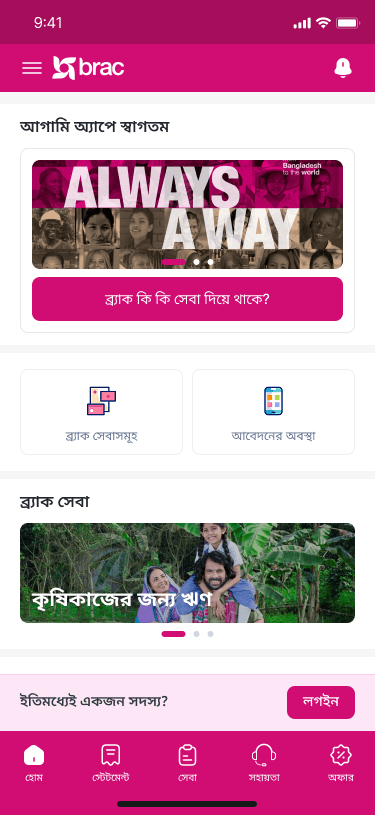
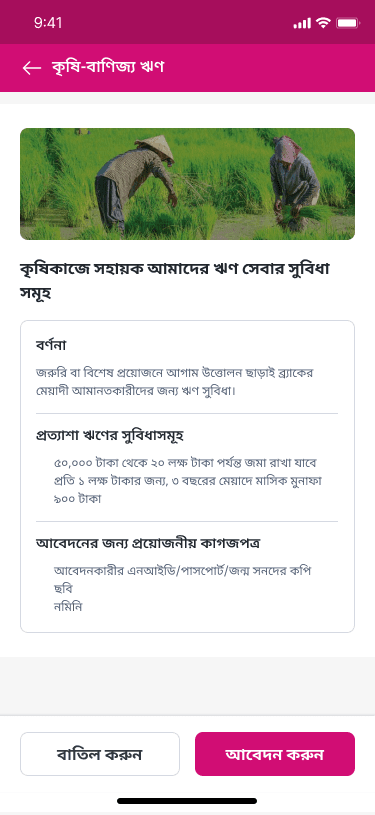
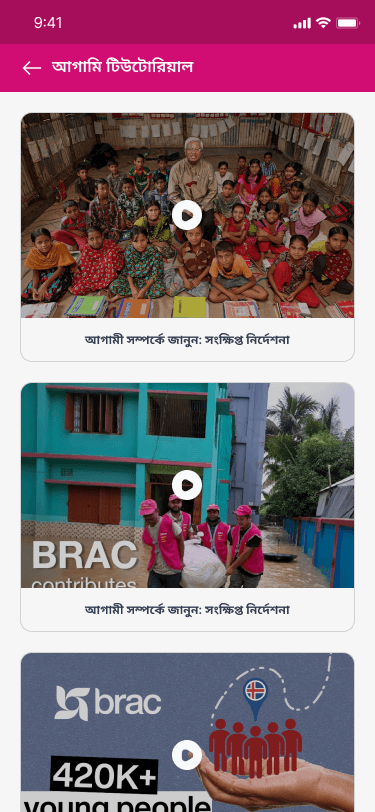
Non-client Onboarding
Changed Agami from a servicing-only app into a digital acquisition channel.
Non-client Onboarding
Changed Agami from a servicing-only app into a digital acquisition channel.
Product decision
New users could enter Agami, learn what BRAC Microfinance offered, and express membership intent directly from the app instead of starting only through offline channels.
Step 01
Land
A public home made Agami useful before login.
Step 02
Explore
Product pages explained BRAC Microfinance offerings inside the app.
Step 03
Apply
Interested users could move toward membership without starting at a branch.
Transaction System
Introduced a transaction layer while keeping operational risk visible to the product team.
Transaction System
Introduced a transaction layer while keeping operational risk visible to the product team.
Step 01
Verify user
Confirm identity before exposing transfer actions.
Step 02
Review details
Show balance, beneficiary, limits, and the action summary.
Step 03
Confirm safely
Use clear confirmation, OTP, failure handling, and reconciliation rules.
Institutional complexity
Agami operated inside a large microfinance ecosystem with branch operations, back-office records, manual business day closure, approvals, delayed dates, and reconciliation needs. The transaction UX had to stay simple while the backend process remained safe.
Field officer homage
The press-and-hold confirmation modal features a cycling BRAC officer, a small tribute to the field officers who travelled by bike to reach clients at home.
Improving Agami User Experience
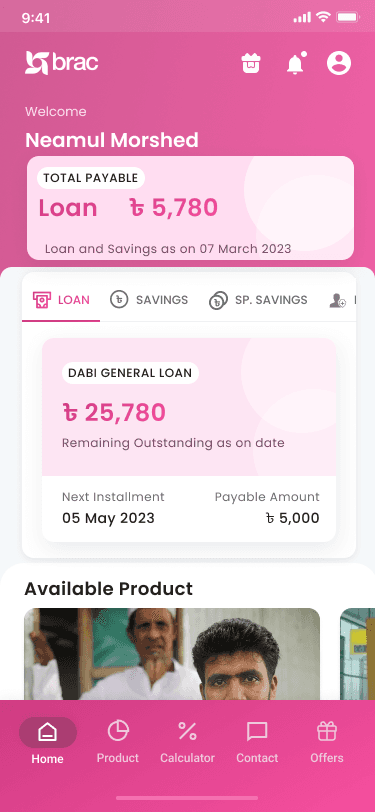
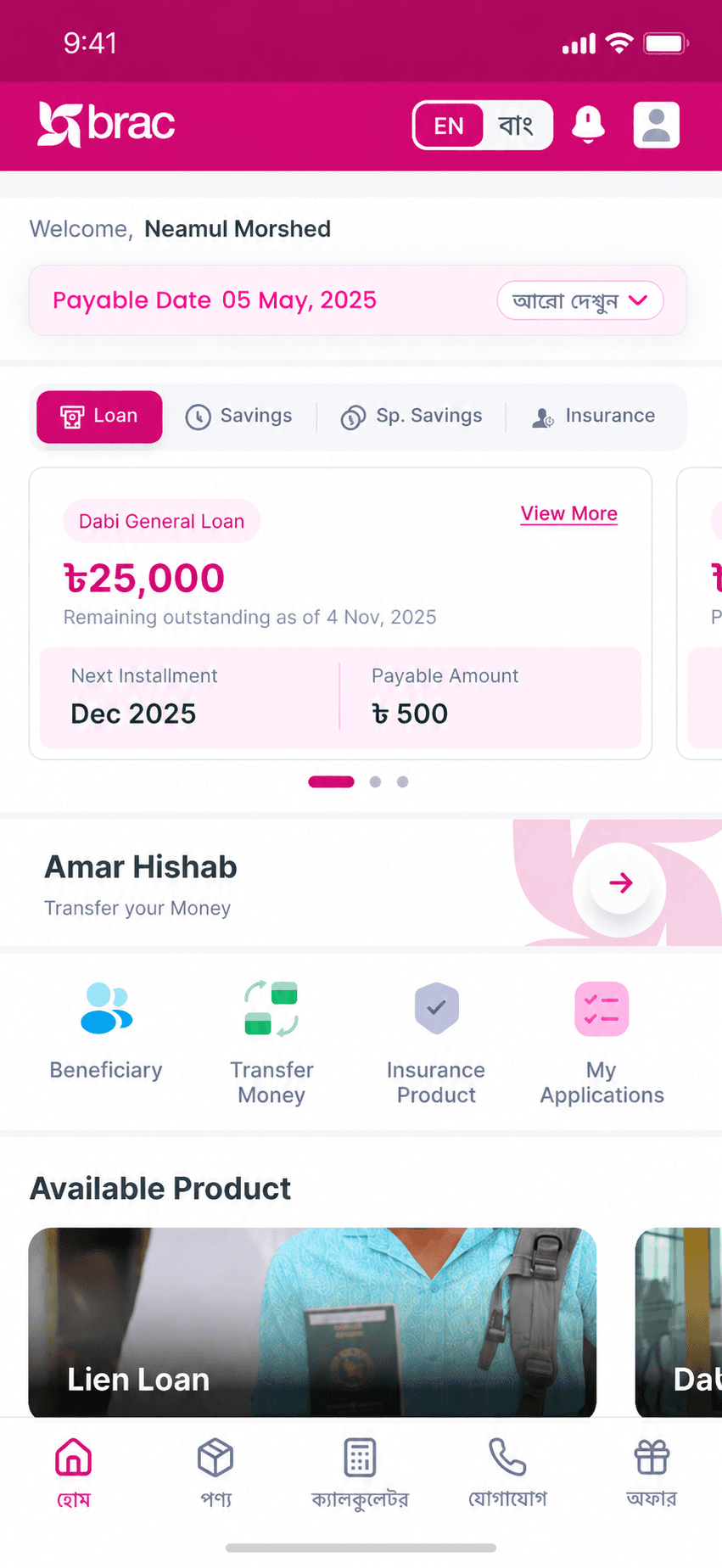
Made the home experience easier to scan as Agami added more products, content, and actions.
Improving Agami User Experience
Made the home experience easier to scan as Agami added more products, content, and actions.
UX modernization
As Agami expanded, the old home screen had to carry more product types and more financial actions. The redesign reorganized information around clearer summaries, faster actions, better visibility, and a more scalable navigation model.
Reduced cognitive load for low-confidence digital finance users.
Created clearer space for transactions, insurance, applications, products, and content.
Content Management System
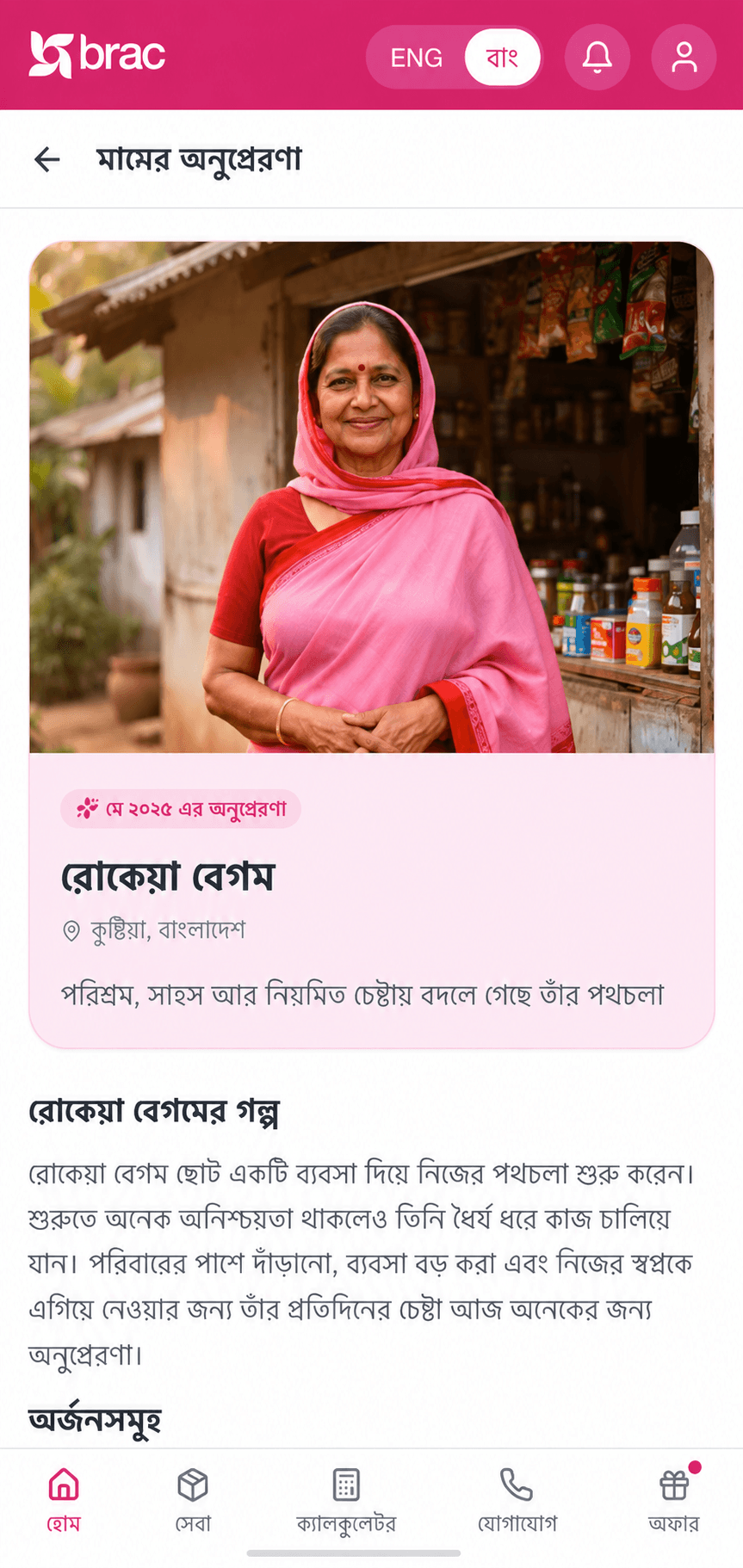
Gave teams a safer way to update live app content without every change going through engineering.
Content Management System
Gave teams a safer way to update live app content without every change going through engineering.
CMS initiative
From hard-coded content to managed product surfaces
The CMS initiative made Agami easier to operate as a live product by giving non-engineering teams controlled ways to update content, offers, and educational surfaces.
Input
Business content
Offers, messages, education, and product copy that changed as Agami evolved.
Control
CMS rules
Structured fields and publishing ownership reduced engineering dependency.
Output
Live app updates
Teams could update app surfaces faster while keeping content controlled.
Analytics Dashboard
Moved the team from scattered reporting toward product intelligence.
Analytics Dashboard
Moved the team from scattered reporting toward product intelligence.
Product intelligence
A shared view of product health
Combining business reporting with Firebase events helped stakeholders see downloads, logins, feature usage, drop-offs, and opportunities for improvement in one place.
Collect
Events and reports
Bring Firebase events and business metrics into one shared view.
Understand
Behavior patterns
Track feature usage, drop-offs, logins, and engagement across the product.
Act
Product decisions
Give teams a better signal for prioritization, iteration, and stakeholder updates.
04. Outcome
Agami became more than a read-only financial dashboard.
It became a digital acquisition channel, a transaction utility layer, a CMS-driven product surface, and a product intelligence platform for BRAC Microfinance.
More importantly, Agami became a stronger foundation for serving underserved entrepreneurs at scale.
Shifted from passive viewing to repeat fintech utility.
Opened a digital route for non-client education and demand.
Built a stronger base for content, analytics, and scale.
Join the conversation
Share a thought, ask a question, or react with a like or dislike. Comments are powered by GitHub Discussions.